
NAP consistency is one of the most misunderstood elements of local SEO.
Some businesses obsess over it and see no ranking movement at all.
Others ignore it entirely – and quietly cap their local visibility without realising why.
The difference isn’t whether your name, address, and phone number are “correct”. It’s whether NAP inconsistency is actually a limiting factor in your local search environment.
This page explains when NAP consistency affects local rankings, when it doesn’t, and how we decide whether it’s worth fixing at all.
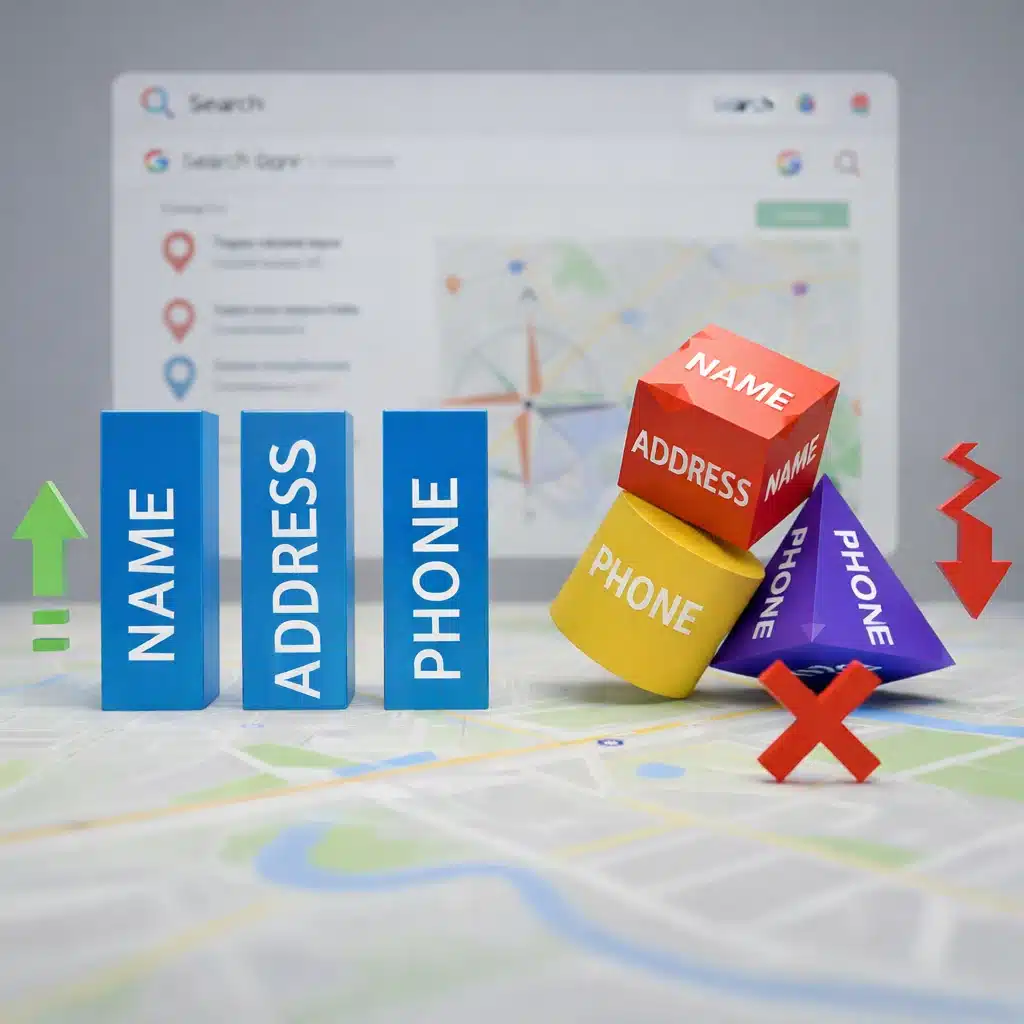
The Summary
NAP consistency does not affect local SEO rankings equally for every business.
In practice, it only becomes a limiting factor when Google lacks confidence in other trust signals – such as brand authority, review depth, or link consistency. For established businesses with strong local signals, minor NAP inconsistencies are often ignored. For newer, multi-location, or recently changed businesses, they can quietly cap local visibility.
The key is not whether NAP is “correct”, but whether inconsistency is currently increasing uncertainty in Google’s local trust model. This is why we assess NAP as a risk variable, not a universal ranking lever, before recommending any cleanup work.
The Problem With How NAP Is Usually Explained
Most explanations of NAP focus on what it is and why it matters. That framing creates two common mistakes:
- It implies NAP has the same impact for every business
- It encourages broad clean-ups without considering return or necessity
In reality, Google does not treat NAP as a standalone ranking factor. It uses it as a supporting trust signal – one that only influences rankings when other signals are weak, contradictory, or incomplete.
When NAP Consistency Actually Affects Local SEO
NAP consistency tends to matter when it helps Google resolve uncertainty about a business’s identity or legitimacy. It becomes relevant in the following situations:
Competitive Local Markets
In crowded local SERPs, Google relies more heavily on corroborating data points. Conflicting NAP information increases doubt, which can slow or limit ranking improvements.
Recent Business Changes
NAP inconsistencies have the greatest impact after:
- relocations
- rebrands
- phone number changes
- ownership changes
Outdated citations in these cases actively conflict with newer signals.
Multi-Location or Service-Area Businesses
The more locations or service areas involved, the harder it is for Google to reconcile conflicting data without clean, consistent references.
Weak or Developing Brand Signals
If a business lacks strong:
- branded search demand
- review depth
- authoritative local links
NAP accuracy plays a larger role in establishing baseline trust.
When NAP Consistency Does Not Move the Needle
This is where many businesses waste time and budget. Perfect NAP accuracy often produces no ranking change at all when:
The Brand Is Already Well Understood
Established local brands with strong engagement, reviews, and links are rarely held back by minor inconsistencies.
Rankings Are Limited by Relevance, Not Trust
If performance is constrained by:
- thin service pages
- weak location targeting
- poor engagement
NAP cleanup will not address the real issue.
The Inconsistencies Are Low-Impact
Formatting differences, abbreviations, or minor directory errors are typically ignored once Google is confident in the entity. This is where diminishing returns apply.
The Grapefruit NAP Impact Test
Instead of asking “Is our NAP consistent?”, we ask:
“Is NAP inconsistency currently limiting local visibility?”
We assess this using four variables:
- Business complexity – single location vs multi-location
- Market competition – how tight the local SERP is
- Signal strength – reviews, links, branded searches
- Data volatility – recent changes vs long-term stability
Only when NAP inconsistency overlaps with at least two of these does it become a strategic priority. Otherwise, it’s maintenance – not leverage.
NAP vs Other Local SEO Signals
NAP consistency rarely drives growth on its own. In most local SEO campaigns, it ranks below:
- review velocity and sentiment
- relevance of service and location pages
- quality of inbound local links
- engagement with the Google Business Profile
NAP supports trust. It does not replace authority, relevance, or demand.
Where NAP Problems Still Hide
The most damaging NAP issues aren’t always obvious duplicates.
They often appear as:
- legacy phone numbers on authoritative domains
- incorrect suite numbers tied to strong citations
- merged listings after relocations
- inconsistent brand names across GBP categories
These issues don’t always surface in automated audits – but they can affect how confidently Google resolves a business entity.
So, Should You Fix Your NAP?
Sometimes – but not always.
If local visibility has plateaued and your business fits the high-impact scenarios above, NAP cleanup can remove friction.
If not, your time and budget are usually better spent strengthening higher-leverage signals.
The decision should be based on impact, not convention.
If You’re Unsure Where NAP Fits in Your Local SEO Strategy
Before recommending any citation cleanup, we run a local visibility risk check to determine whether NAP inconsistency is actually holding performance back – or simply creating noise.
That way, effort is spent where it can influence outcomes, not just tidy data.