
Most pages answer local SEO cost with a number. That’s the wrong question. The real cost is determined by competitive pressure, location density, service intent, and execution depth. This page shows how those variables interact — and how to judge whether an SEO proposal is underpowered, misaligned, or wasteful.
This is a decision page, not a pricing page. If you want help applying the model to your category and service areas, request a Cost Alignment Review below.
Request a Cost Alignment Review
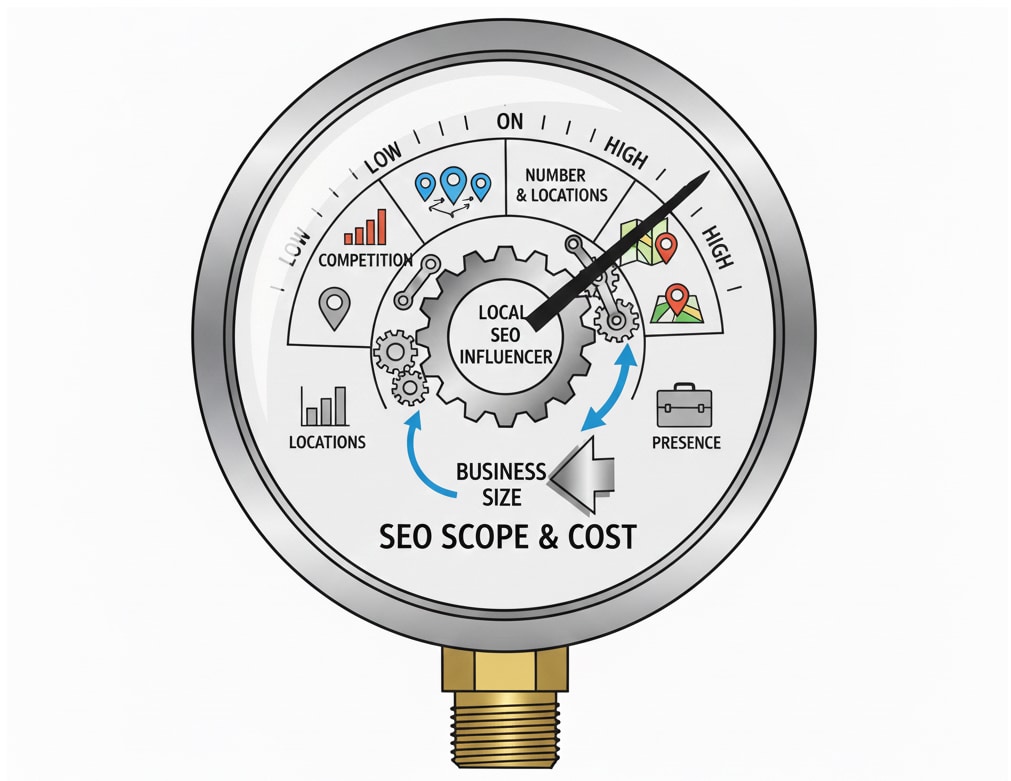
Why “How Much Does Local SEO Cost?” Is Usually the Wrong Question
“Cost” only becomes meaningful when you know what you’re buying against: the competitive environment, how wide the location target is, how valuable the leads are, and how much work is required to close the gap between where you are now and where you need to be.
Two London businesses can pay the same fee and see very different outcomes because the pressure on their local search visibility is different. A realistic budget is the one that matches the pressure.
- If pressure is low: you can win with steady, focused execution.
- If pressure is high: under-scoping becomes the most expensive option.
- If pressure is mixed: the right plan prioritises the variables that matter most.
This is especially true in categories where trust and scrutiny are high — like solicitors and accountants — and in categories where the “local” decision often spans multiple catchments, like training companies serving learners across London.
The Grapefruit Local SEO Cost Pressure Model™
We use a simple lens to explain why local SEO pricing varies — and to help you compare proposals fairly. Local SEO “cost” rises when pressure increases across multiple variables. It’s not about agencies charging more; it’s about what the environment demands to win.
The 5 Cost Pressure Variables
- Search Competition Density
How many serious competitors are actively targeting the same local intent — and how entrenched they are (reviews, authority, content depth, brand signals). - Location Granularity
Single area vs. multiple boroughs/postcodes, commuter overlap, and whether you’re competing across “micro-markets” that each behave differently in search. - Service Intent Depth
Are people searching in urgency mode (high conversion intent) or in research mode (more comparison, more proof, more decision support required)? - Asset Deficit
The gap between your current assets (site structure, service pages, reviews, local relevance, authority signals) and what the SERP winners already have. - Execution Bandwidth
The velocity required to make meaningful change: how much needs doing, how quickly, and how consistently.
Bottom line: local SEO budgets are best treated as a fit question — “what level of execution matches my pressure?” — not a shopping question.
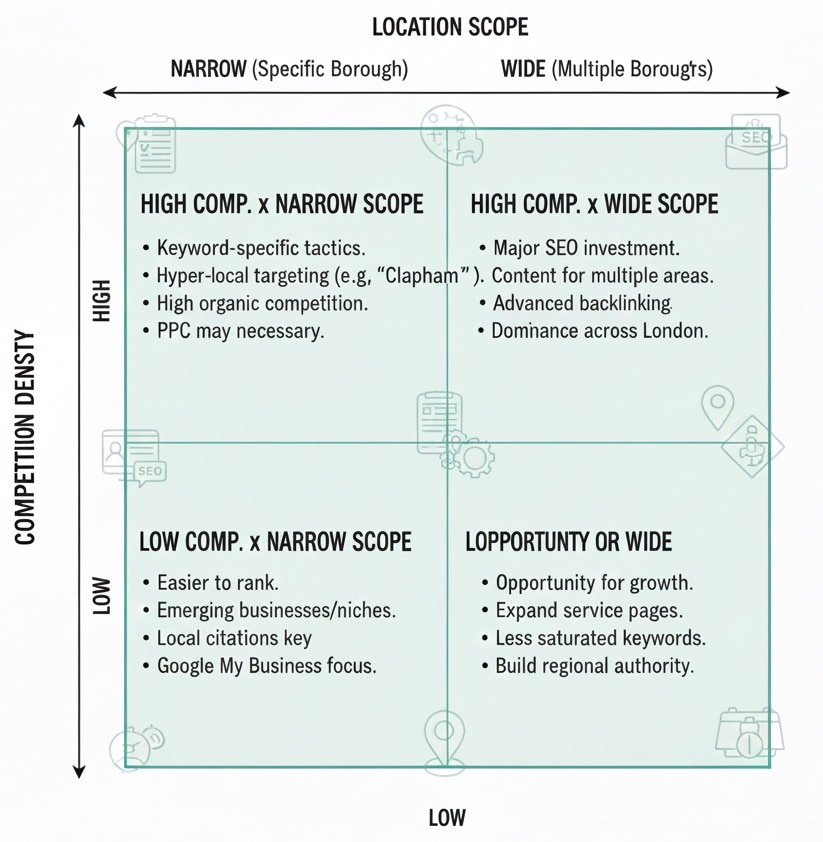
What Drives Local SEO Cost — And Why It Matters
Use the table below to compare local SEO proposals based on what actually drives workload and outcomes. If a proposal ignores a high-pressure factor, it’s usually either padded with generic deliverables or too thin to deliver.
| Variable | Low Pressure Scenario | High Pressure Scenario | Buyer Risk If Ignored |
|---|---|---|---|
| Competition Density | Few serious rivals; weak local footprints | Saturated SERPs; entrenched winners | Underpowered strategy that never catches up |
| Location Scope | Single local area / clear catchment | Multiple boroughs/postcodes; overlap markets | Diluted visibility and scattered effort |
| Intent Value | Lower-ticket, lower scrutiny | High-value leads; high trust requirement | ROI expectations don’t match execution |
| Asset Deficit | Strong base: reviews, pages, relevance | Weak/inconsistent signals; thin site depth | Slow or stalled results; constant rework |
| Required Velocity | Incremental gains acceptable | Rapid displacement needed to win | Budget misalignment: too slow to matter |
Insights That Usually Change the Decision
1) Why identical SEO “packages” produce wildly different outcomes in London
“Packages” assume the environment is predictable. In London, it rarely is. When you buy a package, you’re often buying a task list — not a strategy that adapts to pressure. That’s why proposals can look similar on paper, but perform very differently in practice.
2) The hidden cost of under-scoping local SEO work
Under-scoping looks cheaper upfront, but it commonly turns into wasted months, duplicated work, and a second agency change. If pressure is high, “minimum viable SEO” is usually just delay.
3) Why review velocity can matter more than link volume (in trust-heavy categories)
In categories like solicitors and accountants, trust signals can dominate the decision. If competitors are consistently earning reviews (and you aren’t), you can end up optimising a site that still doesn’t look credible to users — or the algorithm.
4) The “local” trap for training companies: you may be competing across multiple micro-markets
Many training companies serve learners across London rather than a single neighbourhood. That often means multiple service-area intents (and multiple competitor sets) even when your offering is one product. The scope changes because the search landscape changes by area and by intent.
5) How to tell if an SEO proposal is padded or dangerously thin
- Padded: lots of activity metrics, little prioritisation, weak connection to pressure variables.
- Thin: ignores high-pressure factors (competition/location/asset deficit) and still implies outcomes.
- Aligned: explains which variables are driving scope and what trade-offs you’re making.
Optional proof insert (keep it specific):
For a [solicitor/accountant/training provider] in [borough or postcode cluster], the main pressure was [competition density / location scope / asset deficit]. We prioritised [the 1–2 variables addressed first] to reduce friction in the customer journey and improve qualified enquiry quality.
Quick Self-Check: Is Local SEO Worth Prioritising Right Now?
Answer these honestly. If you tick mostly “no”, your best next step may not be “more SEO”.
- Do you serve customers in clearly defined London catchments (or clear service-area clusters)?
- Can you respond to enquiries quickly and consistently?
- Do you have (or can you build) a credible review presence?
- Is your offer clear and easy to compare (services, specialisms, outcomes, constraints)?
- Would more qualified local demand materially change the business in the next 90–180 days?
If you’re unsure, a fast way to reduce uncertainty is to score your situation against the five pressure variables.

Request a Local SEO Cost Alignment Review
If you want a clearer answer than “it depends”, we’ll apply the Grapefruit Local SEO Cost Pressure Model™ to your category, your London service areas, and your current assets — then recommend what level of execution is realistic to win (and what trade-offs you’d be making at lower scope).
What you’ll get:
- A pressure assessment across the 5 variables
- What’s likely driving scope (and what’s not)
- Where most proposals under-scope or over-scope
- A practical next-step recommendation (even if it’s not SEO)
Request a Cost Alignment Review
Note: We don’t publish generic price ranges because they create false comparisons. This review is designed to make proposals comparable and decisions safer.
Related: Local SEO (London) | Case Studies | About Grapefruit Digital